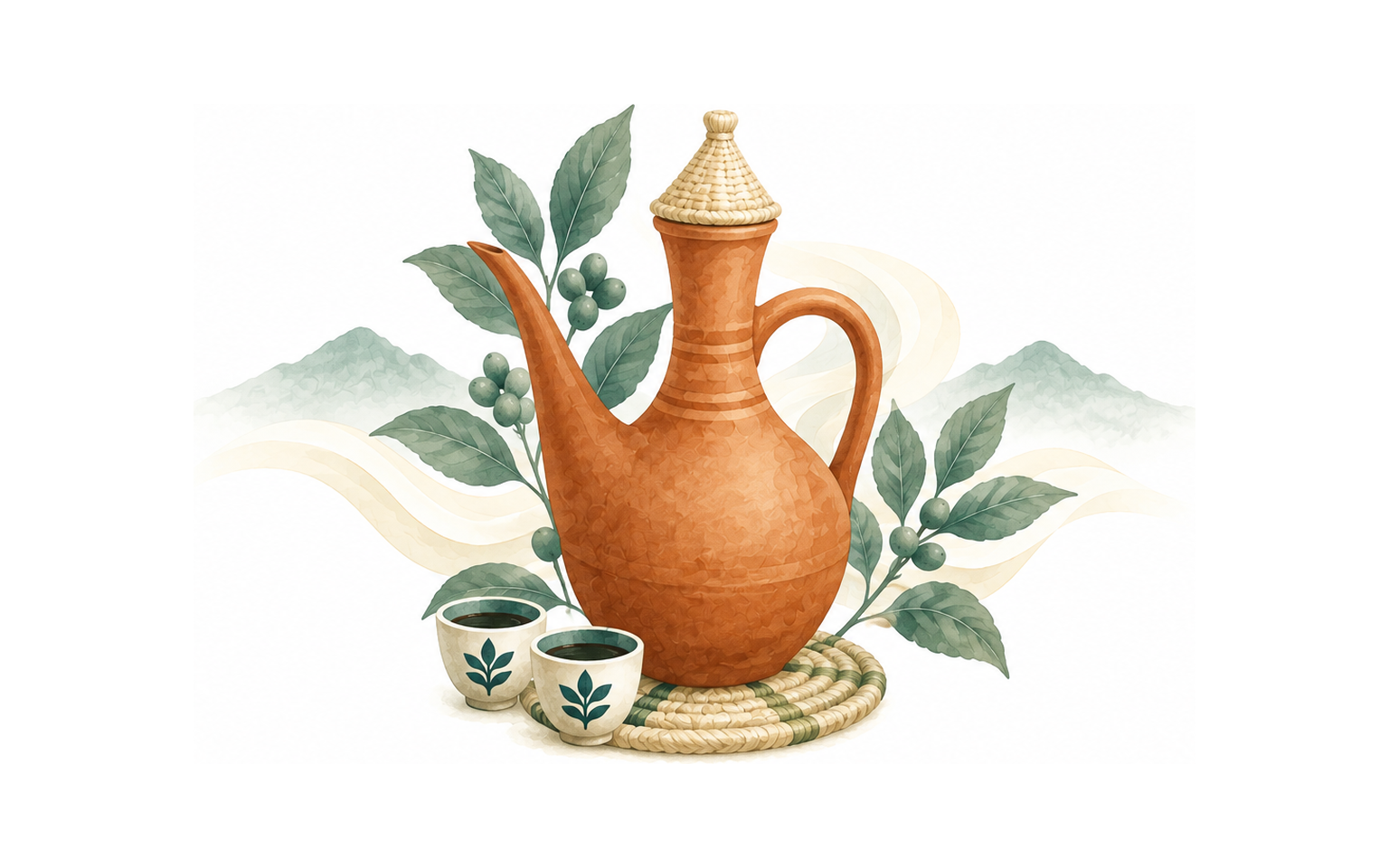
Watercolour illustration of Ethiopian coffee ceremony vessels.
Illustration — Ethiopian Tradition

Buna

Coffee ceremony

An Ethiopian hosting ceremony in which coffee is roasted, ground and brewed in front of guests and served over three unhurried rounds.

Irreducible Action Gathering
Modality Communal Ritual
Intent Social Connection, Hospitality, Rest
Lineage Ethiopian Hospitality Tradition
Lineage Relationship Original
Origin / Codification c. 1400s

What Is It?

Green beans are washed and roasted in the room, the smoke offered around the company, then ground and brewed in a clay jebena and poured from height into small handleless cups. The ceremony runs in three rounds — abol, tona and baraka — and is not hurried: an hour or more is ordinary. Incense is commonly burned alongside, grass is spread on the floor, and the occasion is as much the point as the coffee, since it is how a household receives guests and settles matters.

Geographical Origin & Distribution

Central to household hospitality across Ethiopia and Eritrea, and carried into diaspora communities worldwide.
  • OriginEthiopia
  • Commonly PractisedHorn of Africa, global diaspora
Explore on map

Taxonomy & Details

Lineage
Ethiopian Hospitality Tradition
Lineage Relationship
Original
Origin / Codification Date
c. 1400s
Modality
Communal Ritual
Irreducible Action
Gathering
Associated Actions
Roasting, Brewing, Serving, Conversing
Typical Duration
60–120 minutes per ceremony
Typical Frequency
Daily to weekly
Delivery Format
In-person (host-led)
Participation Format
Group / Host-led
Setting
Home / Indoor
Required Materials / Tools
Green coffee beans, roasting pan, jebena, cups, brazier, incense
Temperature Range
Hot (roasting and brewing)
Intensity
Low
Life Stage Suitability
All ages (children served lightly or not at all)
Contraindications / Precautions
Caffeine sensitivity, pregnancy (intake limits), reflux, smoke sensitivity in closed rooms
Complementary Practices
Communal Meals, Rest, Conversation
Keywords
Coffee, Hospitality, Ceremony, Social Connection, Ethiopian Tradition

References

  1. Ethnographic accounts of Ethiopian household hospitality.
  2. UNESCO and national heritage documentation of coffee culture.
  3. Literature on social connection and shared ritual.

Entries are reviewed against the governance process. Wellbeink records practices; it does not recommend them.