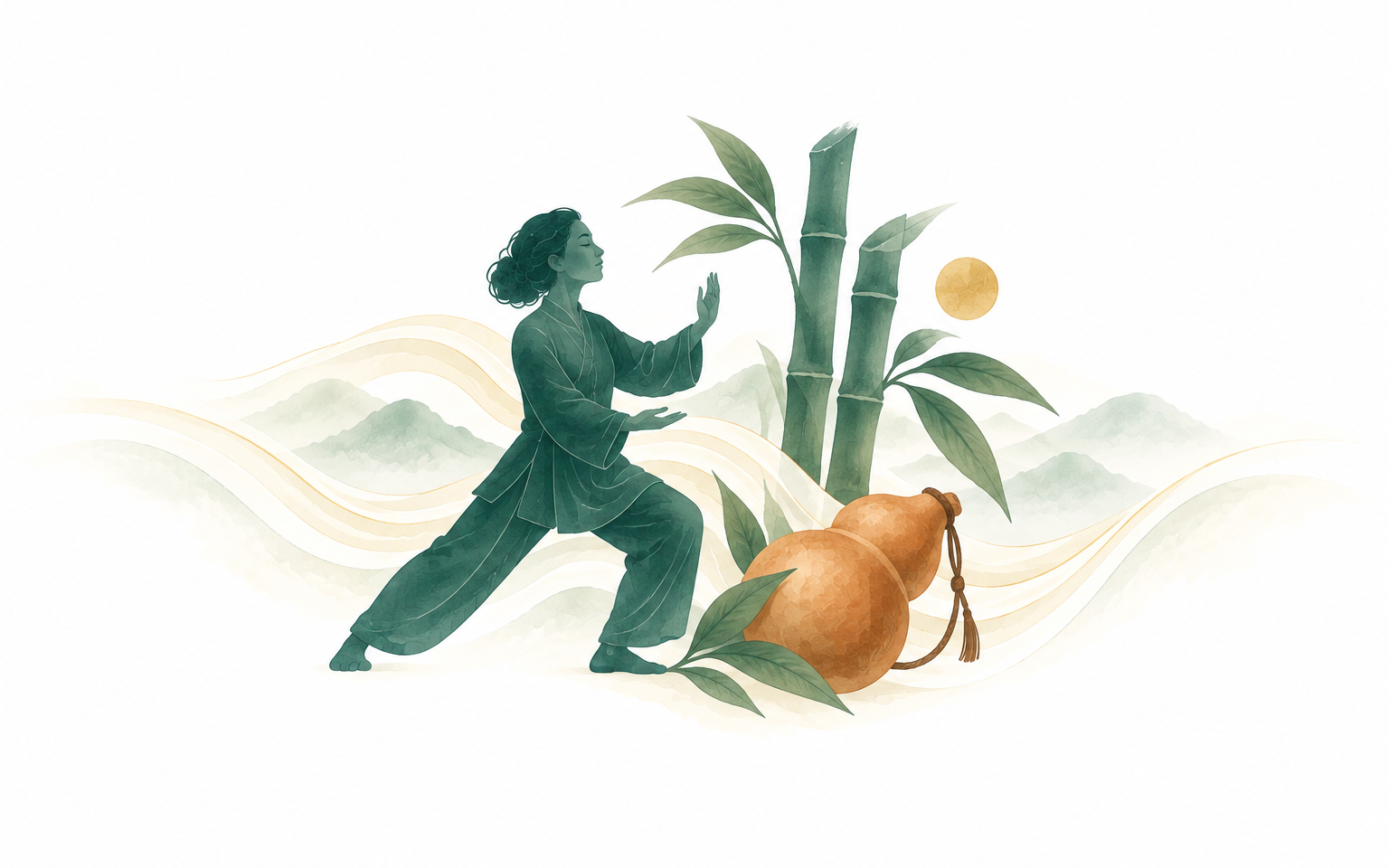
Watercolour illustration of a Chinese movement practice.
Illustration — Chinese Tradition

Qigong

Breath and movement work

A Chinese practice pairing slow, repeated movement with regulated breathing and settled attention, usually standing.

Irreducible Action Moving
Modality Movement & Breath
Intent Relaxation, Balance, Vitality
Lineage Chinese Medicine & Daoist Practice
Lineage Relationship Original
Origin / Codification c. 200 BCE

What Is It?

Qigong sets a small number of movements, often eight to eighteen, and repeats them at a steady unhurried pace while the breath is kept long and even. Postures are mostly standing, with the knees soft and the spine upright; some forms are seated or lying. The emphasis falls on coordination of movement, breath and attention rather than on strength or range, which is why the same form can be practised by a beginner and by someone forty years in.

Geographical Origin & Distribution

Transmitted through medical, martial and monastic lineages, and now taught in community and clinical settings on every continent.
  • OriginChina
  • Commonly PractisedWorldwide
Explore on map

Taxonomy & Details

Lineage
Chinese Medicine & Daoist Practice
Lineage Relationship
Original
Origin / Codification Date
c. 200 BCE
Modality
Movement & Breath
Irreducible Action
Moving
Associated Actions
Breathing, Standing, Stretching
Typical Duration
15–45 minutes per session
Typical Frequency
3–7 times per week
Delivery Format
In-person or remote (teacher-led or self-practice)
Participation Format
Self-guided / Group
Setting
Indoor / Outdoor
Required Materials / Tools
Level ground, loose clothing, flat shoes or bare feet
Temperature Range
Ambient
Intensity
Low to Moderate
Life Stage Suitability
All ages (seated variants for limited mobility)
Contraindications / Precautions
Acute joint injury, severe balance impairment, uncontrolled hypertension (for forceful breath forms)
Complementary Practices
Meditation, Walking, Breathwork
Keywords
Movement, Breath Regulation, Standing Practice, Chinese Tradition

References

  1. Systematic reviews of gentle movement practice and balance in older adults.
  2. Historical surveys of daoyin and later qigong forms.
  3. Teaching-lineage documentation of the standard eight-movement sets.

Entries are reviewed against the governance process. Wellbeink records practices; it does not recommend them.